
Vacuum Plasma Treatment for Medical Device Manufacturing
Medical device manufacturers must produce components that meet strict requirements for cleanliness, adhesion, reliability, and biocompatibility. Vacuum plasma treatment has become one of the most effective surface preparation technologies because it modifies only the outer molecular layer of a material without damaging the underlying component.
Using Nordson MARCH vacuum plasma systems, manufacturers can remove organic contamination, activate surfaces for stronger adhesive bonding, improve wettability, and prepare components for coatings and printing—all without solvents or abrasive cleaning methods. This dry, low-temperature process supports highly repeatable manufacturing while protecting heat-sensitive materials commonly used in medical devices.
Whether manufacturing catheters, implantable devices, guidewires, diagnostic equipment, or surgical instruments, vacuum plasma treatment helps improve product quality, manufacturing consistency, and downstream process performance.
What Is Vacuum Plasma Treatment?
Vacuum plasma treatment is a low-pressure surface modification process performed inside a sealed vacuum chamber. During processing, gases such as oxygen, argon, nitrogen, helium, or fluorinated gases are energized using 13.56 MHz RF power to generate plasma.
The reactive particles created within the plasma interact only with the outermost molecular layers of the material. This allows manufacturers to precisely modify surface properties while leaving the bulk material unchanged.
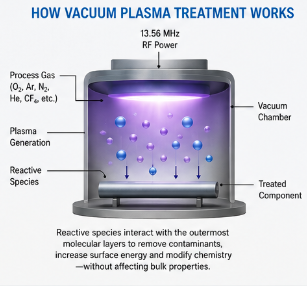
Depending on the selected process gas and recipe, vacuum plasma treatment can:
- Remove organic contaminants
- Increase surface energy
- Improve wettability
- Promote stronger adhesive bonding
- Prepare surfaces for coatings and printing
- Modify surface chemistry without changing mechanical properties
Because plasma treatment is a low-temperature process, delicate polymers, elastomers, metals, and assembled medical components can often be processed without thermal damage or dimensional changes.
How Vacuum Plasma Improves Medical Device Manufacturing
Surface Cleaning Without Solvents
Even microscopic levels of contamination can reduce adhesive strength, coating performance, and manufacturing consistency. Oils, mold release agents, fingerprints, and processing residues frequently remain on components after molding or machining.
Vacuum plasma cleaning removes these contaminants without chemicals, leaving ultra-clean surfaces ready for downstream manufacturing.
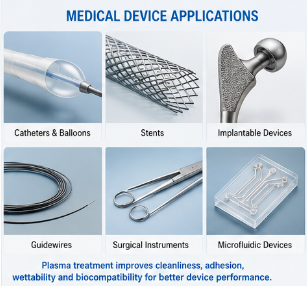
Common applications include:
- Catheters
- Implantable devices
- Surgical instruments
- Stents
- Diagnostic components
- Microfluidic devices
Surface Activation for Stronger Adhesive Bonding
Many polymers used in medical devices—including Nylon, Pebax®, PTFE, and PEEK—have naturally low surface energy, making adhesive bonding more difficult.
Oxygen plasma treatment introduces polar functional groups that significantly increase surface energy, allowing adhesives to wet the surface more effectively and create stronger, more reliable bonds.
Benefits include:
- Increased adhesive strength
- Improved coating adhesion
- Reduced bond failures
- Higher manufacturing yields
- More consistent assembly processes
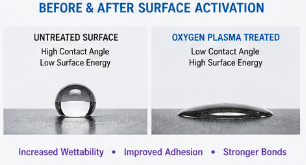
Typical bonding applications include:
- Catheter assembly
- Balloon bonding
- Polymer-to-metal bonding
- Polymer-to-polymer bonding
- UV adhesive preparation
- Overmolding
Preparing Surfaces for Hydrophilic Coatings
Many minimally invasive medical devices require lubricious surfaces to improve navigation through the body.
Vacuum plasma treatment is commonly used before applying hydrophilic coatings because it improves coating adhesion and increases long-term coating durability.
Typical applications include:
- Guidewires
- Catheters
- Endoscopic devices
- Delivery systems
Silicone Surface Modification
Silicone components are widely used throughout the medical industry but often exhibit surface tack that complicates automated handling and assembly.
Plasma treatment modifies the silicone surface, reducing tackiness while improving handling characteristics and preparing the material for adhesive bonding or coating processes.
Common silicone components include:
- Medical tubing
- Seals
- Gaskets
- Molded silicone components
Surface Modification for Improved Biocompatibility
Vacuum plasma treatment can also modify surface chemistry to improve how medical devices interact with biological environments.
Depending on the selected plasma chemistry, manufacturers can increase either hydrophilicity or hydrophobicity while preparing surfaces for additional coating or deposition processes.
Applications include:
- Implantable medical devices
- Biosensors
- Drug-delivery systems
- Tissue-contacting components
Uniform Plasma Treatment for Long Medical Components
Many medical devices—including catheters and guidewires—require consistent surface treatment across their entire length.
Specialized Nordson MARCH plasma systems with extended processing chambers provide uniform plasma exposure for long components, helping manufacturers achieve consistent bonding, coating adhesion, and surface activation from end to end.
Why Medical Device Manufacturers Choose Vacuum Plasma Treatment
Compared to traditional wet chemical cleaning methods, vacuum plasma treatment offers numerous manufacturing advantages.
Key benefits include:
- Solvent-free and environmentally responsible processing
- Uniform treatment across complex geometries
- Low-temperature processing for heat-sensitive materials
- Excellent process repeatability
- Compatibility with polymers, elastomers, metals, ceramics, and composites
- Recipe control for validated manufacturing environments
- Process logging and traceability for regulated production
These advantages make vacuum plasma treatment an essential process in modern medical device manufacturing.
Materials Commonly Treated with MARCH Plasma Systems
Nordson MARCH plasma systems are routinely used to process a wide variety of medical materials, including:
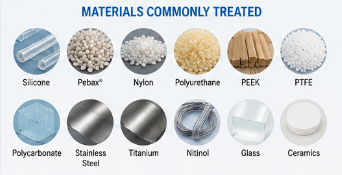
- Silicone
- Pebax®
- Nylon
- Polyurethane
- PEEK
- PTFE
- Polycarbonate
- Stainless steel
- Titanium
- Nitinol
- Glass
- Ceramics
Because plasma modifies only the outer molecular surface, these materials can often be treated without altering their bulk mechanical properties.
Conclusion
Vacuum plasma treatment has become a critical technology in medical device manufacturing because it improves surface cleanliness, increases surface energy, enhances adhesive bonding, and prepares components for coating without affecting the underlying material.
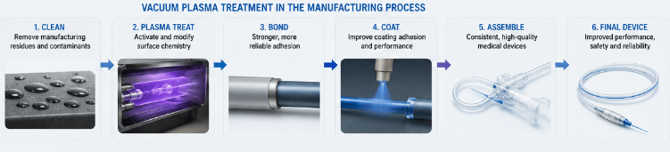
From cleaning implantable devices and activating polymer surfaces to preparing catheters for hydrophilic coatings, Nordson MARCH vacuum plasma systems provide a repeatable, low-temperature, and environmentally responsible solution for improving manufacturing quality and process consistency.
Manufacturers seeking higher yields, stronger bonds, and more reliable downstream processing continue to rely on vacuum plasma technology as an integral part of advanced medical device production.